History of ocarina 2
 |
| |
 |
| |
 |
| |
 |
The earliest predecessors of the ocarina were made of natural materials
such as stone, wood, bone, shell and gourd. By 4000 BCE the Chinese were
making clay whistles and early versions of the Xun (Fig 1). Throughout
Latin America, pre-Columbian clay vessel flutes were made in large
numbers and various forms, including those of animals, birds and people.
In Africa, vessel flutes are made mainly from gourds and fruit shells. The
rhonge is a vessel flute of the Tsonga people, made of a ripe dry sala fruit,
played mostly by herd-boys. Kenyan bushmen blow into animal shells or
cupped hands to imitate the call of the honey-guide bird. Whirling
aerophones in the form of gourds tied to lengths of twine and swung
through the air to make a sound as they travel (a distinctive note is
produced internally by a hole cut in the side) have been found in the
rainforests of the Amazon and Papua New Guinea.
such as stone, wood, bone, shell and gourd. By 4000 BCE the Chinese were
making clay whistles and early versions of the Xun (Fig 1). Throughout
Latin America, pre-Columbian clay vessel flutes were made in large
numbers and various forms, including those of animals, birds and people.
In Africa, vessel flutes are made mainly from gourds and fruit shells. The
rhonge is a vessel flute of the Tsonga people, made of a ripe dry sala fruit,
played mostly by herd-boys. Kenyan bushmen blow into animal shells or
cupped hands to imitate the call of the honey-guide bird. Whirling
aerophones in the form of gourds tied to lengths of twine and swung
through the air to make a sound as they travel (a distinctive note is
produced internally by a hole cut in the side) have been found in the
rainforests of the Amazon and Papua New Guinea.

| Fig 1. Chinese Xun, Photo by: Chu Po Ming, 朱普明 |
In Europe, by the mid-l9th century, clay bird-whistles had become popular
as children’s toys, and were sold at markets and fairs. Donati’s ocarina
was a transformation of the simple clay whistle, having up to 10 finger-and
thumb-holes and tuned to a full Western scale. By 1863 Donati had joined
with others to perform five-part harmony on different-sized ocarinas. They
played traditional tunes from their home region and arrangements of
popular themes from Italian opera. Donati continued to make ocarinas in
Budrio, while his fellow performers toured concert halls across Europe
from 1870 onwards. They amazed audiences with their wonderful sound,
skilful execution and unusual appearance dressed as the ‘Mountaineers
of the Apennines’ (Fig.3). Some of these performers became makers
themselves, returning to Budrio, where the tradition of ocarina making
and playing continues to the present day. Others went on to establish
manufacturing and sales in other parts of Europe, including Paris and
London. Donati’s success led him to move to larger premises in Bologna;
he eventually settled in Milan, where, he continued making ocarinas into
his old age.
as children’s toys, and were sold at markets and fairs. Donati’s ocarina
was a transformation of the simple clay whistle, having up to 10 finger-and
thumb-holes and tuned to a full Western scale. By 1863 Donati had joined
with others to perform five-part harmony on different-sized ocarinas. They
played traditional tunes from their home region and arrangements of
popular themes from Italian opera. Donati continued to make ocarinas in
Budrio, while his fellow performers toured concert halls across Europe
from 1870 onwards. They amazed audiences with their wonderful sound,
skilful execution and unusual appearance dressed as the ‘Mountaineers
of the Apennines’ (Fig.3). Some of these performers became makers
themselves, returning to Budrio, where the tradition of ocarina making
and playing continues to the present day. Others went on to establish
manufacturing and sales in other parts of Europe, including Paris and
London. Donati’s success led him to move to larger premises in Bologna;
he eventually settled in Milan, where, he continued making ocarinas into
his old age.

Fig 2. Giuseppe Donati, Italian inventor of
the classical ocarina, with his work.
the classical ocarina, with his work.
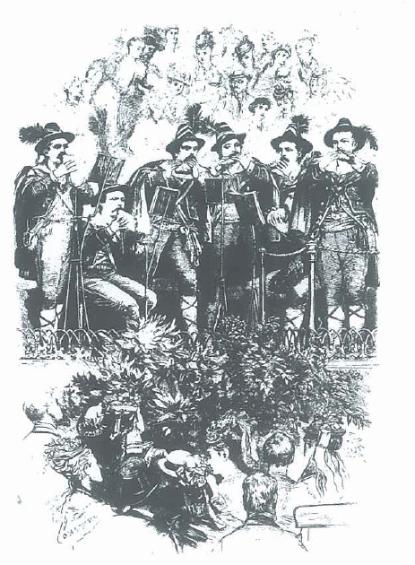
| Fig 3 Mountaineers of the Apennines |

